
Reviewed · BORDEAUX HISTORY & LANDMARKS TOURS
2-Hour Walking Tour of the City’s Iconic Sights and History
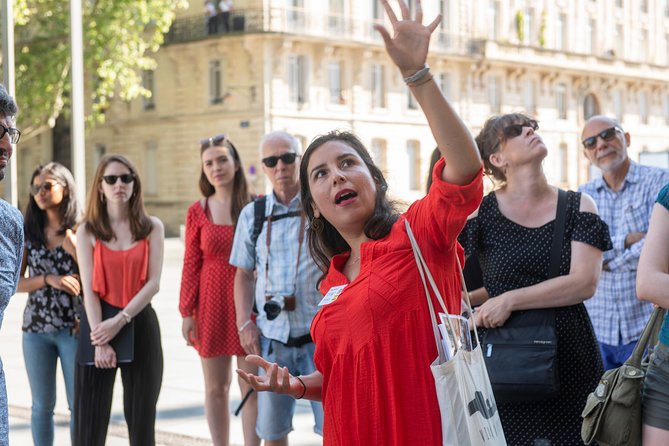
Two hours, one smart route through Bordeaux. This walk is built for quick orientation: you trace the city’s most famous landmarks while a licensed guide explains how they connect to Bordeaux’s past and present. You’ll hit Place de la Bourse, the Grand Théâtre, and the Monument aux Girondins without getting lost in detours.
What I like most is how the tour gives you a clean overview of the city center with stops that actually help you understand the layout. I also like that the best guides manage the pacing well—people highlight guides like Bruno, Christine, Hubert, Nicholas, Jenny, Veronique, and Carol for being funny, clear, and full of details. One drawback to consider: the experience is bilingual (English and French), and on mixed-language groups the English you hear can vary a lot, especially if audio devices don’t work smoothly.
If you want two hours that leave you with names, context, and a sense of where to roam next, this is a solid way to start. If you’re very sensitive to hearing every word in English, you’ll want to keep an eye on audio and group language balance.
In This Review
- Key things you’ll get from this Bordeaux highlights walk
- Starting on the clock: where your Bordeaux walk begins
- The Monument aux Girondins: the city’s revolutionary bookmark
- A classic promenade reset at Allées de Tourny
- Notre-Dame de Bordeaux: a Baroque interior you’ll want to remember
- Place de la Comédie and the Grand Théâtre: the postcard meets the structure
- Rue Sainte-Catherine: your walking shortcut through Bordeaux’s pedestrian heart
- Place du Parlement: a quieter square with a lively pulse
- Place de la Bourse and the Miroir d’eau: the river becomes part of the story
- Price and value for a 2-hour, guided orientation
- Pace, group size, and the sound check issue
- Who this tour suits best (and who should skip it)
- Should you book this 2-hour Bordeaux highlights walk?
- FAQ
- How long is the walking tour?
- How much does the tour cost?
- What language is the commentary in?
- Where do I meet the guide?
- Is the tour mostly walking, or is there a lot of stopping?
- What should I bring?
Key things you’ll get from this Bordeaux highlights walk
- Big-name landmarks in a tight loop: Monument aux Girondins, Place de la Bourse, and the Grand Théâtre.
- Licensed local guidance: a professional guide runs the show and ties sights to stories.
- River-and-architecture pacing: Garonne river views plus 18th-century planning landmarks.
- Pedestrian-friendly center: mostly easy walking for a 2-hour tour.
- Photo stops that make sense: you pause where the buildings and squares are actually worth seeing up close.
- Language balance matters: bilingual commentary can mean different levels of detail for English speakers.
Bordeaux at walking pace, more routes
- Private – Best of Bordeaux Walking Tour + Glass of Bordeaux Wine★ 5.0 · 240 reviews
- Professional – Bordeaux Wine and Cheese Tasting with a walking tour★ 5.0 · 218 reviews
- 2-Hour Walking Tour of the City’s Iconic Sights and History★ 4.0 · 207 reviews
- Bordeaux: Mystery and Myths Walking Tour★ 4.8 · 187 reviews
Starting on the clock: where your Bordeaux walk begins
Your tour meets at the Office de Tourisme et des Congrès de Bordeaux Métropole (12 Cr du 30 Juillet), with the start time listed as 10:30 am. Expect to find a guide, then move into the historic streets right away—this is not a long “gather and wait” kind of tour when things are running smoothly.
One practical thing: the exact meeting spot can be easy to misread because the “office” sounds like one location, but in reality you may need to step fully inside and follow staff instructions. If you’re the type who gets stressed by unclear meeting points, arrive a few minutes early and take a quick look around for where groups are forming.
The walk itself is designed for a 2-hour pace, and you should be ready to walk that entire time. The route can also shift depending on weather and group size, so don’t assume a rigid street-by-street checklist.
The Monument aux Girondins: the city’s revolutionary bookmark
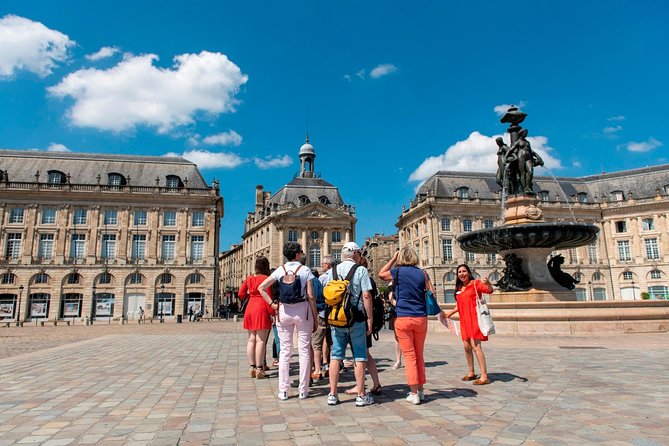
The first major anchor is the Monument aux Girondins, set in Place des Quinconces. This isn’t just a pretty focal point. It’s a dramatic, tall column with fountains and bronze sculpture that marks the Girondists—18th-century political figures executed in 1793 during the French Revolution.
Here’s why this stop matters for your visit: it gives you a thread to follow through Bordeaux. You’ll see how public monuments were used to make political meaning visible in stone and bronze. And because the monument includes a winged Statue of Liberty figure crowning the column, it’s an easy stop for photos that also has a clear story behind it.
It’s also a quick win. You’ll be in and out in about 5 minutes, so it sets the tone without eating your walking time.
A classic promenade reset at Allées de Tourny
Next up is the Allées de Tourny, which is essentially Bordeaux’s elegant promenade moment—think refined 18th-century architecture and the kind of street life that makes the city feel lived-in rather than staged.
This stop works as a breather between bigger monuments. You’re transitioning from one story to the next, and the wide, lined streets give your eyes time to adjust. If it’s busy, you’ll still have enough room to look closely at façades and get your bearings.
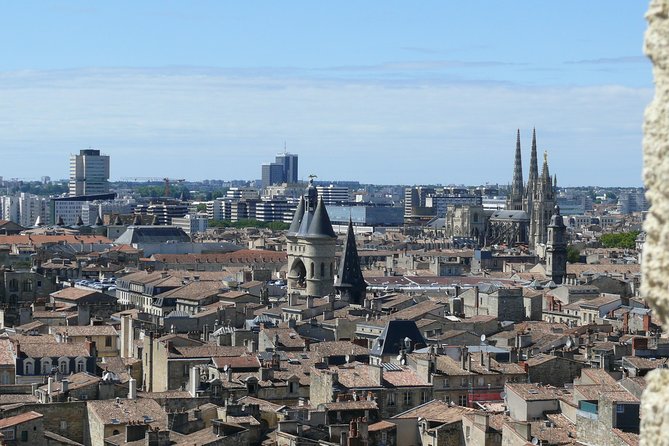
The whole city in one sweep, more ways to see it



Notre-Dame de Bordeaux: a Baroque interior you’ll want to remember
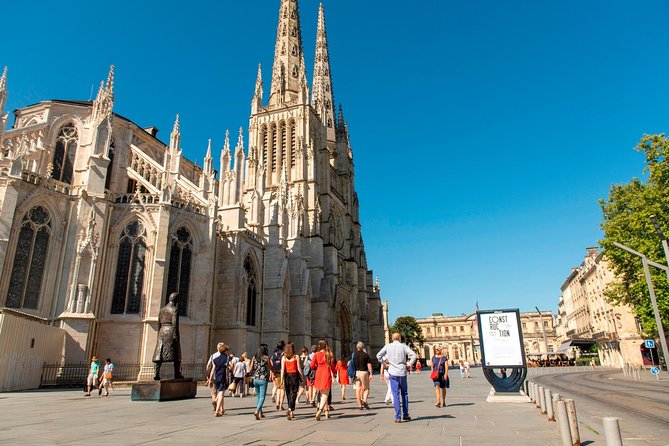
Then you’ll reach the Église Notre-Dame de Bordeaux, a Baroque church known for its sculpted façade and vaulted interior. The key value here is perspective: Bordeaux isn’t only about plazas and grand theaters. It also has religious architecture that rewards attention to details.
Even if you don’t go inside every time, the stop frames how the city’s style developed. Baroque churches can feel like they’re telling you how to look, and that’s exactly what helps you “read” Bordeaux later when you’re wandering on your own.
This is another quick 5-minute stop, so treat it like a highlight preview. If you want more, plan extra time afterward.
Place de la Comédie and the Grand Théâtre: the postcard meets the structure
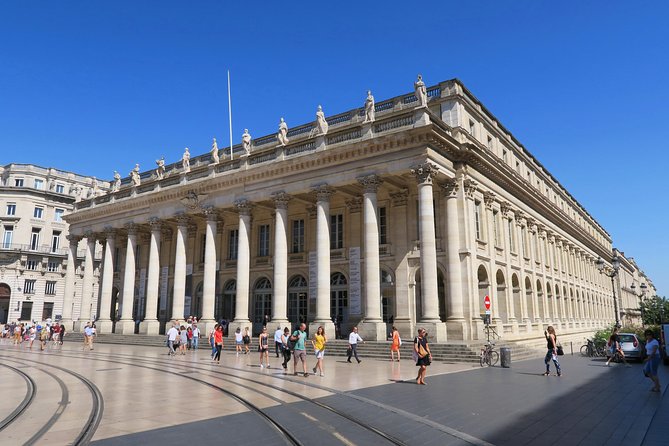
No Bordeaux highlights walk is complete without the Place de la Comédie and the Grand Théâtre. This is where the city’s theatrical side shows up, in stone and symmetry.
At the square, you’re surrounded by the energy of restaurants and shops, and the Grand Théâtre dominates the view. The tour describes it as neoclassical, completed in 1780, and closely tied to the growth of Bordeaux’s wealth—especially the emerging bourgeoisie. In other words, this wasn’t built for modesty. It was built to show arrival, power, and taste.
One fun detail to listen for: the theater stands where a Roman temple once sat. Even if you won’t see Roman ruins today, the point is that the spot has mattered for a long time.
On the practical side, you get short photo time outside the portico and façade. This is also a good place to stop and ask the guide one question about what to see next, because after the theater your route shifts toward the river-side icons.
Rue Sainte-Catherine: your walking shortcut through Bordeaux’s pedestrian heart
Between the big squares, the tour includes Rue Sainte-Catherine, described as a major traffic-free pedestrian avenue. This is one of Europe’s longest pedestrianized shopping streets, and it matters because it’s how you experience the city in “motion.”
You’ll likely pass chic shops and places to eat, which makes this stretch useful even if you’re not shopping. It’s where you can feel the city’s rhythm. Also, it’s practical: walking along a lively pedestrian street keeps your bearings solid.
If you’re traveling with kids, this part can be the easiest segment—there’s room to move and something visually interesting happening nearly every block.
Place du Parlement: a quieter square with a lively pulse
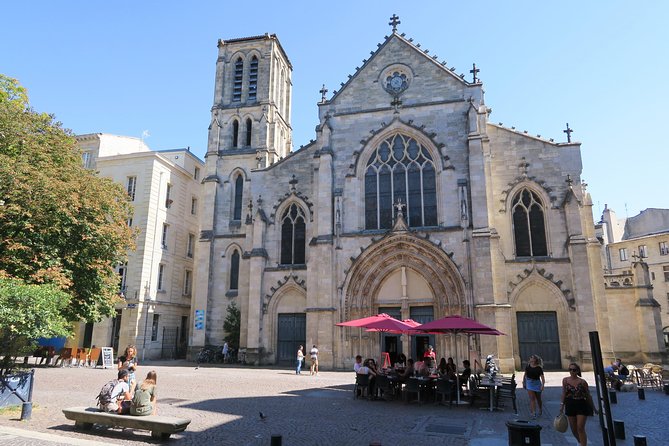
Then comes Place du Parlement, another classic square stop, framed by historic architecture and cafés. This is the kind of stop that’s short on time but useful for understanding the city’s street design: squares here aren’t empty monuments. They’re social rooms.
You’ll get about 5 minutes, so don’t expect a long sit-down. Instead, use it to watch people, scan the building edges, and connect the square’s feel to the kind of city life Bordeaux still has today.
Place de la Bourse and the Miroir d’eau: the river becomes part of the story
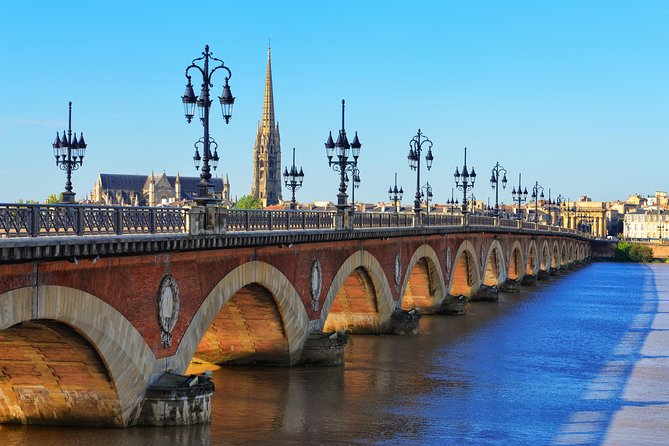
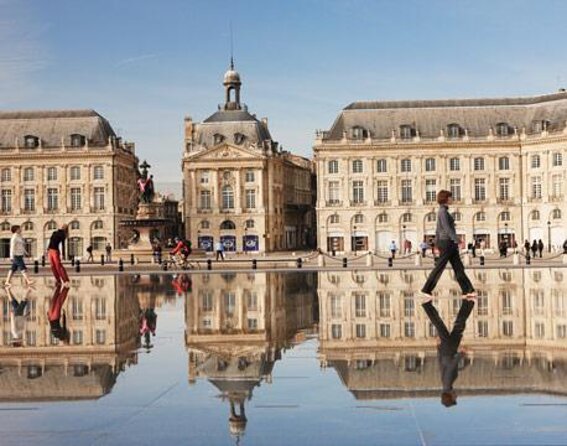
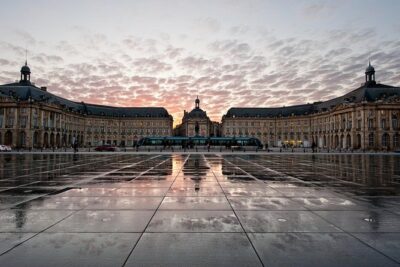
You’ll finish at Place de la Bourse, one of Bordeaux’s most recognizable spots, facing the Garonne River. This is the area that most people associate with Bordeaux’s elegance, in part because of the classical architecture and the famous reflective feature called the Miroir d’eau.
The Bourse square also ties directly to the city’s economic identity. It was created in the 18th century by architect Ange-Jacques Gabriel, so you’re looking at the “planning mindset” behind the city’s grand public spaces. The reflective water element makes it feel current and photo-friendly, especially in changing light.
The tour ends back near this area. The end point can shift based on the guide, weather, and group movement, but Place de la Bourse is the stated destination.
Price and value for a 2-hour, guided orientation
At $17.37 per person for about 2 hours, this tour is priced like a fast city-orientation product rather than a full-day deep dive. That’s a good thing if your goal is to get oriented quickly and learn how the major landmarks connect.
What you’re buying is not transportation or meals. You’re buying a licensed guide, a structured route through key sights, and context you can reuse later when you wander independently. And because the stops are free to visit (as described for the main landmarks), the value mostly comes from interpretation, not ticketed attractions.
The biggest variable is the guide and the language mix. If your group includes many French speakers, English delivery may feel less detailed or less constant. If you really care about hearing every word in English, bring patience—or be strategic and ask your guide questions right after a stop when there’s a natural pause.
Pace, group size, and the sound check issue
This tour caps at 25 travelers, which is small enough to feel manageable, but large enough that you need to stay attentive to the guide. The guide can’t personally track down each person at the office, so when the group is called forward, follow the guide right away.
A few reviews also point to a practical detail: you might be given audio devices or earphones to hear the commentary. When those devices work, it’s a huge improvement—especially with a bilingual format. When they don’t work, you lose clarity fast. If you’re handed equipment, test it early.
Also, while the tour is described as English-offered, it’s clearly a bilingual setup (English and French). Some guides reportedly switch languages smoothly; others can sound less balanced if the guide is supporting a mostly French-speaking segment alongside you. That’s not always fixable from your side, but you can manage it: listen for the big takeaways, then ask targeted questions to fill the gaps.
Who this tour suits best (and who should skip it)
This walking tour is a great fit if you want:
- a first-time orientation in Bordeaux,
- an easy, central route that hits monuments you’ll see anyway,
- and a guide who can explain what you’re looking at while you move.
It’s a less perfect fit if you:
- need continuous, high-detail English-only commentary,
- dislike any chance of sound issues,
- or expect a very broad tour that includes every major church and landmark in the old city.
One complaint that pops up is that the walk can feel like it covers only a subset of what someone might hope to see in 2 hours. That’s normal. Two hours can’t cover everything. Think of this as the scaffolding tour. Then you build your own afternoon from what clicks.
Should you book this 2-hour Bordeaux highlights walk?
I’d book it if you want a confident starting point. You’ll get the monuments that define the city—Monument aux Girondins, the theater at Place de la Comédie, and the iconic Place de la Bourse with the river view. And you’ll likely leave with enough context to plan your next stops without guessing.
I’d hesitate if English clarity is your top priority. Because the tour is bilingual and group composition can affect how much detail you hear, you may want to come in flexible, ready to enjoy the sights even if every sentence isn’t perfectly delivered in your language.
If the idea is to walk, look, and learn enough to steer your day, this is a strong use of your time in Bordeaux.
FAQ
How long is the walking tour?
The duration is about 2 hours.
How much does the tour cost?
The price is $17.37 per person.
What language is the commentary in?
The tour offers English, and the commentary is described as bilingual in English and French.
Where do I meet the guide?
You meet at Office de Tourisme et des Congrès de Bordeaux Métropole, 12 Cr du 30 Juillet, 33000 Bordeaux.
Is the tour mostly walking, or is there a lot of stopping?
It’s a walking tour with short stops at key landmarks. You should be able to walk for the full 2 hours.
What should I bring?
The information says you must bring your own mask, and you should be prepared for walking weather since the route can vary based on conditions.
The Old Port, Up Close






Bordeaux, End to End

Bordeaux on Foot
Just Added: Fresh Bordeaux Reviews

Bordeaux History & Landmarks Tours, compared.
 ★ 4.8Historic Center & Chartrons District Bike TourFrom $42709 reviews
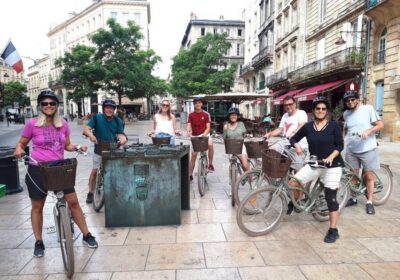 ★ 4.9Top Landmarks & Historic Bike TourFrom $42346 reviews
 ★ 5.0Bordeaux’ Best Boulangeries & History TourFrom $72126 reviews
 ★ 4.9Exclusive! Bordeaux: Nighttime Highlights Walking TourFrom $6485 reviews
 ★ 4.5Bordeaux Historic and Gourmet Food Walking TourFrom $10382 reviews
 ★ 4.0Guided cruise Bordeaux UNESCOFrom $1634 reviews
 ★ 5.0Historical Center, Bordeaux Food TourFrom $14433 reviews
 ★ 5.0Private Bordeaux History Tour with a glass of Bordeaux wine.From $9028 reviews
Browse the lists this tour appears in