Reviewed · BORDEAUX HISTORY & LANDMARKS TOURS
Bordeaux: Wine History Tour with Tasting
Wine tells stories if you know the code. In this 2-hour Bordeaux wine history tour, you follow the Chartrons wine merchants’ trail and finish with a sommelier-led blind tasting that turns confusing bottles into something you can actually decode. You get the city sights with context, not random stops, and the tasting gives you tools you’ll use long after you leave town.
I especially like the way the tour teaches you how a professional approaches a wine without labels in front of them. You’ll learn how to remember Bordeaux wine-village names and how to connect the grapes to what you’re smelling and tasting, not just memorizing facts. And the practical label lesson helps a lot when French wine wording starts to look like it was written for insiders.
One consideration: the walk is built around seeing monuments mostly from the outside. You won’t enter sites, and some are only viewed at a distance while the guide explains what matters.
In This Review
- Key takeaways
- Getting Oriented: the turquoise umbrella at Quai des Chartrons
- Chartrons Wine District: 300 years of merchants and river views
- Saint-Louis des Chartrons: a quick photo stop with a purpose
- CAPC and contemporary Bordeaux: why the city mix matters
- Pont de Pierre: the river crossing that frames your understanding
- Cité du Vin: the wine museum outside view that helps with the label lesson
- The Chartrons waterfront walk: photo moments and a smooth finish at the wine bar
- The Blind Tasting: how you learn to decode Bordeaux wines
- What you learn beyond tasting: grapes, classification, and the 75 cl bottle
- Why French wine labeling is hard (and how this tour helps you cope)
- Price and value: is $76 for 2 hours worth it?
- Who this fits best (and who should choose something else)
- Should you book this Bordeaux wine history tour with tasting?
- FAQ
- Where does the tour start?
- How long is the wine tour?
- How much does it cost?
- What languages are available for the tour?
- What’s included in the tasting?
- Is the tasting blind?
- Will you enter any monuments during the walking portion?
- Is the tour suitable for kids?
- Is the tour wheelchair accessible?
- Is there free cancellation?
Key takeaways
- Blind tasting with a sommelier approach: learn the method, then apply it to Bordeaux wines.
- Chartrons history on foot: follow roughly an hour of walking through a 300-year wine district.
- French wine labels, explained in plain terms: why it’s hard and what to look for anyway.
- Bordeaux Appellation wines + cheese pairing: 4 organic wines (1 white, 2 reds, 1 sweet) with 3 French cheeses.
- Multi-stop riverside route with photo breaks: CAPC, Pont de Pierre, and Cité du Vin views built in.
- English and Spanish guides: groups are led in either language, with past guides including Adrián, Caz, and Clemence.
Bordeaux wine under one roof, more to see
- Bordeaux Wine and Trade Museum Admission Ticket with Wine Tasting★ 4.5 · 599 reviews
- Bordeaux: Museum of Illusions Entry Ticket★ 4.2 · 588 reviews
- Bordeaux: Wine and Trade Museum Entry Ticket & Wine Tasting★ 4.4 · 121 reviews
- Bordeaux: Wine History Tour with Tasting★ 4.8 · 13 reviews
Getting Oriented: the turquoise umbrella at Quai des Chartrons
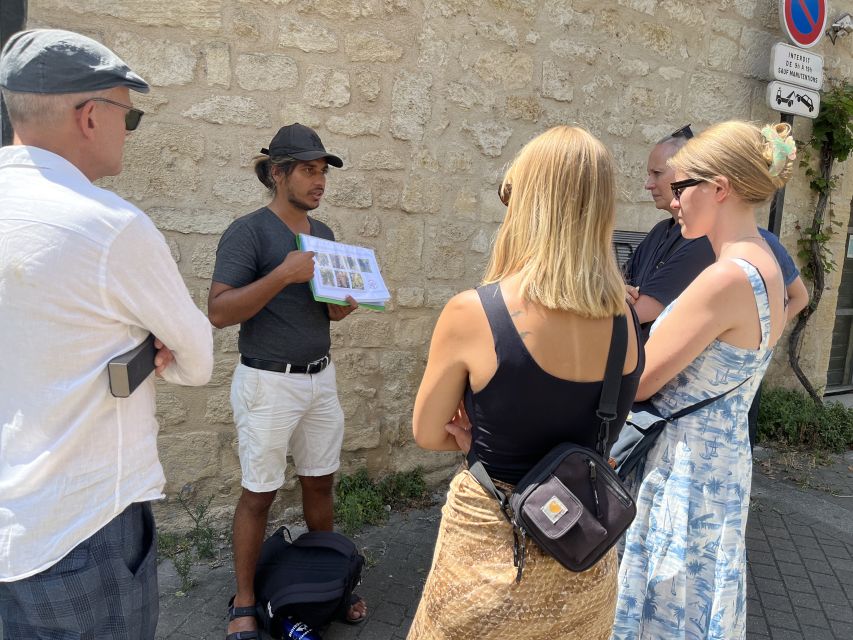
Your tour begins at 64 Quai des Chartrons. Look for your guide holding a turquoise umbrella. It’s such a simple detail, but it saves you time in a waterfront area where it’s easy to second-guess where you’re supposed to stand.
From the start, the plan stays practical. You’re not stuck in a single room for the whole experience. You’ll walk for almost an hour, then you’ll shift into the tasting portion at the end. That mix matters because Bordeaux wine makes more sense when you’ve seen where the trade and the neighborhoods developed.
It’s also worth noting the tour runs for 2 hours, with a mix of moving time and short stop time (think 10–15 minute segments). If you’re on a tight schedule, this is a good length: long enough to learn real wine basics, short enough to still enjoy the city afterward.
Chartrons Wine District: 300 years of merchants and river views
The heart of the experience is Chartrons, the neighborhood tied to wine merchants arriving in Bordeaux centuries ago. The area’s story isn’t just trivia. It’s the reason the city’s wine culture looks the way it does, and why certain traditions and routes became important.
As you walk, you’ll see the riverside and get views that help you picture how wine moved through the city. Even if you’re not a waterfront person, this part lands because it connects the dots between geography and commerce. Bordeaux isn’t only vineyards and labels. It’s also port life, storage, distribution, and the neighborhoods that grew around that system.
This is the moment where you start picking up the tour’s logic: you’ll be learning grapes and terminology while you’re in the place where those ideas became part of local identity. If you like learning by context, you’ll enjoy this section more than a pure museum-style approach.
Saint-Louis des Chartrons: a quick photo stop with a purpose
One of the first structured stops is Église Saint-Louis des Chartrons. Expect a photo stop and then a short visit and walk segment. The important part here is how the guide uses the stop to explain the area’s wine connections.
Because the tour is designed to keep moving, don’t expect a long inside visit. You’re told up front that you won’t enter monuments. Instead, you’ll get the visual reference points so the stories make sense when you later look at maps, photos, or even bottles that refer to these local districts and traditions.
Practical tip: wear shoes you’re comfortable walking in. Even though it’s not an all-day hike, the tour includes repeated walking segments and river-adjacent streets where sidewalks can be uneven.
Deeper into the old port, more history walks

CAPC and contemporary Bordeaux: why the city mix matters
Next you’ll pass by CAPC (Contemporary Art Museum of Bordeaux) for sightseeing and a short walk segment. This stop can feel like a detour if you came only for wine facts. But it’s actually useful.
Wine culture is not trapped in the past. Bordeaux lives in the present too, and the best way to understand that is to see the city’s mix: heritage neighborhoods plus modern cultural spaces. You get a sense of how Bordeaux keeps its identity while evolving, and that makes the wine story feel more real and less like a textbook.
Again, you’re mostly looking from outside and moving on. If you enjoy city context and quick visual anchors, CAPC works well. If you’re only interested in vineyard basics and tasting, you might mentally treat this as a “breather with meaning.”
Pont de Pierre: the river crossing that frames your understanding
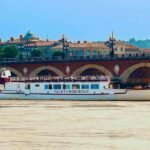
Then comes Pont de Pierre, with sightseeing and a short walk segment. Pont de Pierre is one of those landmarks that instantly signals scale: this is a city built around crossing and connecting zones.
For this tour, it’s not just about taking a photo. The guide uses the vantage point and the movement through the city to reinforce how Bordeaux’s wine world depended on links—between neighborhoods, river access, and the wider region.
If you’re thinking ahead: this is also a good time to look around and orient yourself. Once you’ve walked a few segments, Bordeaux starts to “click” and you’ll better understand where the tasting spot and the wine bar fit into the flow.
Cité du Vin: the wine museum outside view that helps with the label lesson
You’ll also stop at Cité du Vin for sightseeing and walking time. You won’t be going inside on this tour, but it still matters because Cité du Vin is basically a visual reminder that Bordeaux wine is meant to be interpreted, not just consumed.
This sets you up for the later tasting and the label-reading discussion. A wine label is like a map, and that map is easier to read once you’ve seen where wine culture is celebrated and systematized. Even from the outside, Cité du Vin helps you mentally switch from “wine as taste” to “wine as information.”
If it’s raining, this part can be a bit weather-dependent since it’s an outdoor stop. The tour does include several short segments, so you’re rarely stuck out in one place for long.
The Chartrons waterfront walk: photo moments and a smooth finish at the wine bar
You’ll continue through Chartrons for sightseeing, then into the quay area with photo stops and more river views. The tour finishes back at the waterfront, and the endpoint is 24 Quai des Chartrons.
This matters because the tasting feels like a natural continuation, not a separate activity you took a taxi to. You go from learning how the neighborhood connects to wine trade, to putting that learning into practice in a wine bar setting.
And yes, you’ll see plenty of views. Just keep your expectations realistic: the goal isn’t a long scenic cruise. It’s a learning walk with sights that support the wine education.
The Blind Tasting: how you learn to decode Bordeaux wines
The big payoff is the tasting at the end. You’ll do a blind tasting of 4 Bordeaux Appellation wines, paired with 3 French cheeses.
Here’s why the blind tasting is so valuable: it trains your brain to ignore the easy clues. Without labels and without the comfort of guessing based on reputation, you practice identifying structure, aroma cues, and taste profiles. That’s the skill you actually want when you’re standing in a shop later trying to pick a bottle without a sommelier next to you.
You’ll taste:
- 1 white
- 2 reds
- 1 sweet wine
And those are paired with three types of French cheese, which helps you understand how food changes perception. That’s not a gimmick. It’s a real tool: cheese can amplify certain flavors and soften others, so your tasting notes become more accurate when you experience the pairing dynamic.
Past groups have highlighted that the expert guidance makes the learning feel simple. Names that show up in guide mentions include Adrián, Caz, and Clemence—and the consistent theme is clear: you don’t get lost in wine jargon.
What you learn beyond tasting: grapes, classification, and the 75 cl bottle
This tour doesn’t just “talk wine.” It teaches you how to interpret wine information you’ll see on a bottle.
You’ll cover:
- Different grape varieties (so you can connect what you taste with what it’s made from)
- How to read a French wine bottle label
- Why the labeling is so difficult
- The important wine classification concept
- Why bottles are 75 cl
That last detail is small, but it helps. When you understand the standard bottle size, you stop mentally tripping over the formatting and you can focus on the actual meaning: region, appellation, producer cues, and the classification system that French wines use to signal quality tiers and regulations.
And the tour’s emphasis on remembering wine village names is smart for beginners. In Bordeaux, names can pile up fast. If you can attach names to categories, you can start navigating the region confidently rather than feeling overwhelmed.
Why French wine labeling is hard (and how this tour helps you cope)
French wine labels can look like a puzzle because multiple systems overlap at once. You may see place names, appellations, classifications, and grape or producer information, all competing for your attention.
The tour’s approach is to give you a way to prioritize. You’ll learn what matters first for your expectations—then what to read next for nuance. That’s how you avoid the common beginner mistake: trying to understand everything in one glance.
You’ll also get context for Bordeaux classification, which is one of the reasons Bordeaux can feel more intimidating than other regions. The classification system helps buyers and drinkers make choices, but it only works if you know what the label parts are actually communicating.
By the time you’re in the tasting, the label lesson isn’t theoretical. You can connect the wine you’re tasting to the type of information found on bottles. That’s the moment where the confusion becomes practical understanding.
Price and value: is $76 for 2 hours worth it?
At $76 per person for 2 hours, you’re paying for three things: a guided walking component, expert teaching, and a structured tasting with included drinks.
You get:
- 4 glasses of Bordeaux organic wines
- 1 white, 2 reds, 1 sweet
- Pairing with 3 French cheeses
- A wine expert or sommelier guiding you through the tasting and explanations
That’s not just a casual “try some wine.” The blind tasting plus cheese pairing gives you a repeatable learning experience. You’re also getting education on label reading and classification, which can save you time and frustration when you shop for wine later.
The only cost warning is straightforward: extra pours at the wine bar are not included, so if you plan to keep drinking after the tasting portion, budget for it.
In plain terms: if you want to leave Bordeaux with bottle-confidence (not just a pleasant evening), this price is easier to justify.
Who this fits best (and who should choose something else)
This is a strong choice if you:
- Want a short, focused Bordeaux wine introduction
- Like guided city walks with real context
- Want help understanding French wine labels without getting overwhelmed
- Enjoy tasting with structure, especially a blind tasting format
It may not be the right fit if:
- You’re traveling with children under 18
- You’re pregnant (this tour is listed as not suitable)
- You prefer tours that include long visits inside major sites (this one keeps you mostly outside, with some monuments seen from a distance)
On the practical side, the tour is listed as wheelchair accessible, which can matter for mobility planning. Still, it’s a walking tour, so wear comfortable clothing and shoes, and dress for the weather.
Should you book this Bordeaux wine history tour with tasting?
Book it if you want real learning in a compact format: Chartrons history you can visualize, plus a tasting that teaches you how to think, not just what to drink. The blind tasting and cheese pairing make this feel like a guided skill-building session, not a rushed sample flight.
Skip it only if you’re expecting lots of inside monument time or you already feel fluent in French wine labeling and classification. Otherwise, this is a smart way to turn Bordeaux from an intimidating label shelf into a set of understandable categories you can explore on your own.
If you’re in Bordeaux for a short stay and you want maximum payoff per hour, this one is built for that.
FAQ
Where does the tour start?
The meeting point is 64 Quai des Chartrons. Your guide will be holding a turquoise umbrella.
How long is the wine tour?
The tour lasts 2 hours.
How much does it cost?
The price is $76 per person.
What languages are available for the tour?
The live tour guide speaks English and Spanish.
What’s included in the tasting?
You’ll receive 4 glasses of Bordeaux organic wines (1 white, 2 reds, 1 sweet) paired with 3 French cheeses.
Is the tasting blind?
Yes. The tour includes a blind tasting of the 4 Bordeaux wines.
Will you enter any monuments during the walking portion?
No. You won’t enter monuments. Some monuments are seen from a distance while the guide explains their story.
Is the tour suitable for kids?
No. It is listed as not suitable for children under 18.
Is the tour wheelchair accessible?
Yes. The tour is listed as wheelchair accessible.
Is there free cancellation?
Yes. You can cancel up to 24 hours in advance for a full refund.
More Tour Reviews in Bordeaux

The Old Port, Up Close
Bordeaux Wine Under One Roof

Just Added: Fresh Bordeaux Reviews
Bordeaux History & Landmarks Tours, compared.
 ★ 4.8Historic Center & Chartrons District Bike TourFrom $42709 reviews
 ★ 4.9Top Landmarks & Historic Bike TourFrom $42346 reviews
 ★ 4.02-Hour Walking Tour of the City’s Iconic Sights and HistoryFrom $17207 reviews
 ★ 5.0Bordeaux’ Best Boulangeries & History TourFrom $72126 reviews
 ★ 4.9Exclusive! Bordeaux: Nighttime Highlights Walking TourFrom $6485 reviews
 ★ 4.5Bordeaux Historic and Gourmet Food Walking TourFrom $10382 reviews
 ★ 4.0Guided cruise Bordeaux UNESCOFrom $1634 reviews
 ★ 5.0Historical Center, Bordeaux Food TourFrom $14433 reviews
Browse the lists this tour appears in